Poker Is it a game of skill or luck ? | The Truth Revealed
A tiny percentage of people might become addicted to poker. If you are losing money that you cannot afford to lose, if you feel that poker is negatively impacting your life, or if you think you could have a gambling addiction, you should get professional help.
At online poker sites, there is always room for those who feel uncomfortable playing poker. You can choose to put time limits on how much you can deposit and how much time you can play with your account, or you can close it completely.
Over time, poker is a skill-based game.
For this reason, we never play for individual hands or even individual sessions when we play poker. Throughout our playing careers, we instead perform for tens of thousands, hundreds of thousands, or even millions of hands.
Because all that probability, arithmetic, and statistics will finally work in our advantage. Naturally, this assumes that you are the one receiving the money in the middle with the majority of the mathematical advantage!
One of the most amazing aspects about this game is that the sucker with QQ actually gets to walk away the winner almost 1 in 5 occasions. Now, before you start screaming heresy, let me a moment to explain.
Is poker a skill-based or chance-based game?
The debate over whether poker is primarily a gambling game or a game of skill is as old as playing cards itself. Is poker more of a chance-based game or a skill-based one? How much of a chance is there in poker? Poker News answers these and other questions.
Is Poker Only a Chance-Based Game?
Some players question whether poker is solely a game of luck because of its gambling component. Poker is a game of chance, no doubt, but skill definitely plays a part, as shown by the fact that the same well-known players routinely win cash games and tournaments. If not, are you suggesting that these elite athletes are just more fortunate than their competitors?
Does playing poker include any luck?
The mathematical foundation of poker forms the basis for its luck component. If you were tossing a coin a billion times, it would land on its head or tails half the time. The odds would be practically 50/50 by the time you reached one billion coin flips, but there would be moments when it kept coming up heads, maybe hundreds or even thousands of times. The bumpy road that leads to the actual 50/50 ratio is called variance.
There is a lot of variance in all poker formats and variants. For example, pocket aces beat a random hand nearly 85% of the time over a large sample size. There may be times, though, when it will seem like your pocket aces are never winning. Players focus on this short-term poker luck rather than the much longer term when the volatility gradually evens out.
Does poker require any particular kind of skill?
Some players deny the existence of poker talent, but they are unable to provide an explanation for the existence of professional players. Do they believe that those that play poker professionally are just lucky than others? Making decisions about which cards to play and which to fold is the first step in the skill component of poker.
Poker skill is also required to outsmart rivals, place the ideal bet to entice them to call or fold, and more. The best poker players study the game extensively, which includes being well-versed in game theory and mathematically sound optimal strategy.
Poker would just be a game of luck without the skill element, with the one with the best luck coming out on top. A less-than-skilled poker player may even triumph in tournaments and win specific pots due to volatility or luck. However, over time, an educated, skillful player will always be in the lead.
Is poker considered gambling?
When reading about poker skill and luck, the question of whether poker constitutes gambling was never brought up. Despite the fact that poker involves some gambling, players maintain that the game is not pure gambling, despite claims to the contrary from non-players. So what exactly is poker?
Poker Is a Math and Odds Game
So how can you really take advantage of the mistakes made by the weaker players and use your advantage? It’s not at all complicated, actually.
Applying this rule consistently is all it takes to succeed at poker:
When you are statistically in the lead, add more money to the pot; when you are statistically behind, add less money.
The other important component of the poker skill edge is bluffing. You can force your opponent to fold a better hand and win more pots than you should by reading them and figuring out when they are weak.
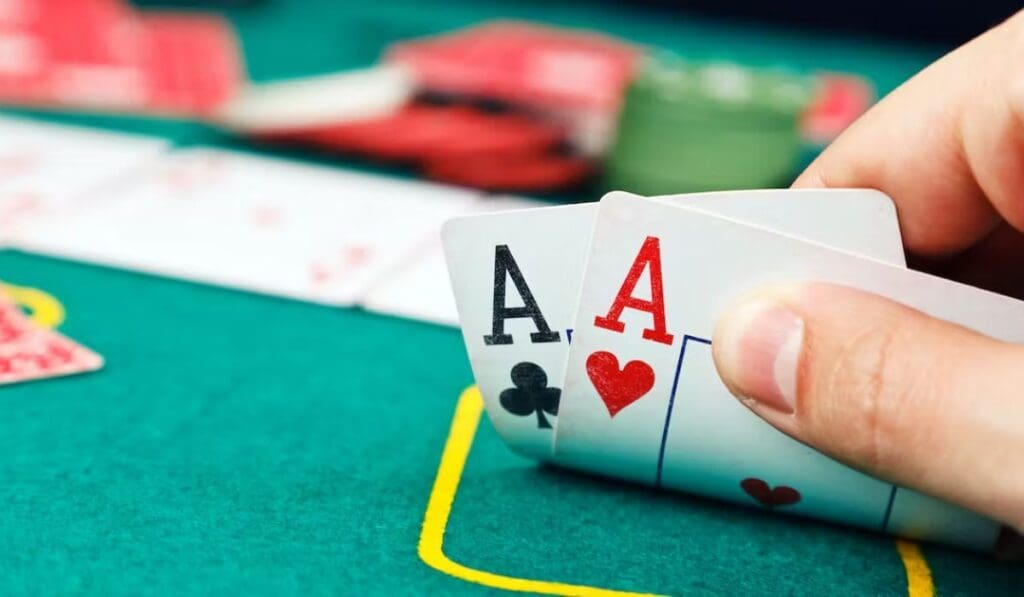
As we can see, pocket aces are a big mathematical favorite to win the hand. They have roughly 81% equity in this situation. However, pocket queens are not exactly drawing dead here. In fact QQ will still win this hand roughly 18% of the time or almost 1 out of every 5 times.
So when the unthinkable happens (QQ wins the hand) this will cause some people to become frustrated and go on tilt and play emotional.
When so called bad beats like this happen this also leads people to believe that poker is just a game of luck.
But from a logical, unemotional standpoint we know that the person holding the QQ is not going to win in the long run. Keep running this same scenario enough times and eventually they will go broke.
You can’t fight math.
On paper, poker is a simple game.
Now, in principle, all of this undoubtedly seems rather simple. Dealing with losses when the arithmetic worked in their favor is the main issue that the majority of poker players have, though.
Let’s take an example where you entered a poker event and patiently played for a few hours. With AA against someone else’s QQ, you eventually won all of the money in the middle before the flop.
Why do individuals engage in gambling?
Most definitions define gambling as taking a risk with something worth in the hopes of winning something equally valuable. When someone places a money wager on an NFL game, they are hoping that their predictions will come true and they will get paid by the bookmaker.
By that definition, poker is gambling since you can wager on the random outcomes of the following card or cards to raise the amount of chips you have. Unlike sports bettors who can merely look at a team’s form, injuries, etc., poker players have some power over the outcome of a hand they play.
Components of Gambling in Poker
Gambling is engaged when attempting to get a straight or flush. This can happen if you bet, raise, or call an opponent while knowing that you need to draw a card to make your hand better. This is gambling as you have no control over it.
Anytime you bluff an opponent: In poker, bluffing is essentially a form of pure gambling since the object of the wager is to force your opponent to fold their hand and award you the pot as a result.
In a tournament setting, you usually move all-in before the flop when you are short-stacked. You are essentially hoping that everyone folds so you can win the blinds and antes, therefore you are gambling by doing this.
It may be considered gambling to estimate your opponent’s range of hands by looking at their cards since you are making assumptions based on incomplete knowledge.
What Separates Poker from Gambling While there is some gambling involved in poker, it is not the same as betting on sports or the roulette wheel. A competent poker player who has put a lot of effort into honing their craft will always come out on top in the long run, even if they lose in the short term due to mathematical instability.
Are Muslims Allowed to Play Poker?
All forms of gambling, including chance-and skill-based games with monetary stakes, are forbidden in Islam. As a Muslim who want to play poker, Poker News suggests getting advice from your Iman.
Is it wrong to play poker?
Many Muslims are curious as to whether poker is forbidden, and various authorities have differing views on the matter. Most scholars agree that gambling of any kind is illegal, especially when it involves money. Again, ask your Iman if you are unsure if it is illegal to play poker.
Conclusion
No one ever promised that poker would be simple. To be honest, it can be one of the most difficult games ever, which is why so few people manage to succeed at it in the long run.
In fact, Phil Ivey, one of the best players of all time, addresses this in his recently released advanced poker training curriculum.
And things have to be this way.
After the house takes its cut, you can only win if someone else is losing. And these are the same individuals that ultimately lose money, either because they were outplayed or because the mental demands of the game proved too much for them to bear.
However, this ultimately doesn’t alter the basic mathematical truth that poker is a game of skill rather than chance. There’s a reason why the same elite pros continue to win year after year.
In the end, you will make money in poker if you continue to apply your statistical edge and skill advantage regularly. It is totally up to you where you decide to go from there.
Finally, be sure to download a copy of my free poker cheat sheet if you want to learn how to start earning $1000 a month from low stakes games.
Please share your opinions in the comments section below. Is poker a skill- or luck-based game?