Master Teen Pati Online Casino: The Ultimate Guide to Playing Like a Pro
Betting
The game typically begins with players contributing an initial stake or boot amount to the pot. The betting sequence commences with the player positioned next to the dealer.
Loose versus tight play
In Teen Patti, the terms loose and tight describe a player’s overall approach to continuing hands beyond the initial round or folding them early. While there isn’t a universally recognized threshold expressed as a percentage or ratio of hands played, a “tight” player typically opts to fold less promising hands, whereas a “loose” player tends to wager on and play through more hands until the final showdown.
Entry fee
The game begins with an ante or boot amount placed in the pot. Players can contribute this ante either through equal contributions from each participant, or through a rotating system where one player puts in a larger amount.
An ante functions as a mandatory wager where each participant contributes an identical amount of money or chips to the pot before dealing begins. This amount typically equals either a single unit (representing the minimum or one-value in play) or a smaller predetermined amount; commonly, it might be set at half or quarter of the minimum bet. The ante system ensures that consistently folding becomes a losing strategy, as players gradually lose money even by folding every hand. This creates a subtle but effective incentive for players to actively participate in hands rather than consistently folding when the opening bet reaches them.
Antes serve to discourage overly cautious play. In games without antes, players who haven’t paid a blind can fold without any financial consequence; the ante system makes excessive folding financially unfavorable. The presence of antes typically results in increased player participation, leading to larger pots and more engaging gameplay.
In variations where the dealer position rotates each round, players often agree to have the dealer (or another designated position relative to the dealer or button) cover the antes for all players. While this streamlines the betting process, it can create slight imbalances when players join or leave the game. During these transitions, players may receive a designated button indicating their obligation to pay an ante (known as “posting”) upon returning to play.
Post
Players who temporarily step away from the table (such as for refreshments or restroom breaks) and miss antes must post to rejoin the game. They are required to pay the applicable ante to the pot for their next participating hand. In such situations, the posting amount corresponds to the ante value that was in effect during their absence.
Posting requirements are typically waived if the player who would otherwise need to post is already participating in the ante. This exemption exists because the strategic advantage of avoiding the ante – namely, participating in multiple hands before making an ante payment – doesn’t apply in this scenario. Consequently, it’s a common practice for newcomers to secure their position at the table and observe several hands before actively participating,
or for returning players to wait until the ante rotation reaches their position, allowing them to enter with the ante payment while avoiding the post requirement. Following this same principle, players can only accumulate one ante at a time; when the ante rotation returns to a player’s position, any previously missed antes are cleared since the player couldn’t have gained any advantage from missing these antes.
Blind
A blind or blind bet represents a mandatory wager that one or more players must place into the pot before the dealing begins, effectively simulating regular betting activity. The most prevalent blind structure involves two distinct positions: the small blind, placed by the player after the dealer, typically amounts to half of a standard bet, while the big blind, placed by the subsequent player, equals a full standard bet. This two-blind framework, occasionally incorporating antes, dominates modern gameplay structures. In some informal settings, particularly when the dealer implements it as a “winner’s fee” from the previous hand, a single blind (either half or full bet) may be utilized.
In addition to mandatory blind bets, players may voluntarily participate in blind betting by placing optional wagers into the pot. When betting blind, players must wager at least half of the current bet level established by players who can see their cards. Conversely, players with visible cards must place bets that are at least double the current blind bet level.
Some gaming circles implement restrictions on blind betting frequency – for instance, limiting players to betting blind only during their first three turns or first two opportunities.
Call and raise (chaal)
Following the ante and mandatory blind bets, regular betting commences with the next player contributing their wager to the pot.
The betting structure comprises two key elements – the call and the raise, collectively known as Chaal. Each participant must match or exceed the previous player’s bet, with the option to increase the wager. This new amount establishes the current betting level (Chaal). Typically, raising limits are enforced, preventing the total bet (including both call and raise) from exceeding twice the previous player’s wager. Additionally, bets must be made in even amounts (2, 4, 6, 8…), particularly when blind players remain active. This even-amount requirement exists because blind players wager half of the standard bet, and odd amounts cannot be equally divided.
It’s crucial to note that this betting framework differs fundamentally from Poker’s structure, as each new bet stands independently of previous wagers. For instance, if a player initiates with a bet of 2 and their opponent raises to 4, the first player must contribute an additional 4 to the pot to call or can opt to raise the stakes to 8. This contrasts with Poker’s mechanics, where the second player would only need to add 2 more to match the level 4 bet.
Limits
The betting constraints, which govern the amounts players can bet or raise, typically manifest in four distinct categories: fixed limit, spread limit, pot limit, and no limit.
Note: These limitations can be applied to either the raise or the bet.
Every such game incorporates both minimum betting requirements and specified maximums, along with a standardized betting unit, representing the smallest permissible betting increment.
Fixed
In fixed-limit betting structures, players can typically raise up to an amount equivalent to the most recent bet (current betting level). Consequently, the maximum raise matches the call amount, while the highest possible bet amounts to twice the previous wager.
Spread
Games featuring a spread-limit structure permit players to raise any sum within predetermined maximum boundaries (while adhering to other betting protocols).
For illustration, in a “$1000 spread-limit” game, participants can call and subsequently raise any amount up to $1000.
A more straightforward interpretation restricts the total bet to the spread-limit amount. Following this example, the maximum combined bet (call plus raise) cannot exceed $1000.
Pot
In pot-limit betting structures, players have the freedom to raise up to an amount matching the total pot size before their raise.
To illustrate this concept, consider a scenario with an initial ante of $50 and a single forced blind bet of $10 at the beginning of the regular betting round, after players have examined their cards. The subsequent player has the option to place a minimum bet of $20, which is twice the previous blind bet of $10. Additionally, this player can raise the stakes up to $80 (calculated from the current pot of $50 + $10 + $20 = $80), establishing a new betting level of $100 ($20 + $80).
Should this player opt for the maximum $100 bet, the pot grows to $160, enabling the next player to either call at $100 or escalate with a raise up to $260, potentially reaching a total bet of $360 (as calling the $100 brings the pot to $260, permitting a raise of that amount). The following player would then face the option to call at $360 and could raise up to $880 (since calling $360 would create a pot of $880, allowing for a raise of that magnitude).
A more streamlined approach involves capping bets at the current pot size. In the scenario above, the first active player could bet between $20 and $60. If they choose the maximum $60 bet, the next player’s options range from a minimum of $60 to a maximum of $120. Should they bet the maximum, the subsequent player’s betting window would span from $120 to $240. Note: This example demonstrates a particular case where later maximum bets are double the minimum due to specific ante and blind bet configurations. Different combinations may not maintain this ratio.
No-limit
In games employing a no-limit betting structure, players have complete freedom to raise the bet by any amount they choose.
Moves
Blind play
Blind play occurs when a player places bets without viewing their cards, relying solely on intuition about their hand’s potential strength relative to opponents. Higher bets typically indicate greater confidence in one’s fortune and anticipated card combination superiority. Conversely, conservative players preferring minimal risk tend to place smaller bets when playing blind.
Play (chaal phase)
Players retain the right to examine their cards at any point and, when their turn arrives, place bets based on their perceived hand strength. They may fold if they deem their cards insufficient, though doing so out of turn, while permitted, is generally considered discourteous. Some variations enforce a rule requiring players to wait for their turn before viewing and folding their cards.
Sideshow, backshow, and compromise.
When a player has viewed their cards, they can request a sideshow after placing their bet. This request can only be made with the previous active player who placed the most recent bet. These sideshows are alternatively known as backshows. However, sideshows are only allowed when no player is playing blind, and if a player makes three consecutive sideshow requests, it becomes mandatory for the requested player to show their cards.
Players have the discretion to either accept or decline sideshow requests from others. A player might choose to decline if they suspect their opponent is bluffing, as the opponent would likely fold with a weak hand during the comparison. Additionally, players holding strong hands might refuse sideshow requests to allow the pot to grow larger, thereby increasing the game’s excitement and potential winnings.
Upon acceptance of a sideshow request, both involved players privately examine each other’s cards. The player holding the inferior hand must fold immediately. In situations where both hands are of equal value, the player who initiated the sideshow request is required to fold.
If a sideshow request is declined, the requesting player must either continue betting to remain in the game or choose to fold.
Show
The betting continues until one of two scenarios unfolds:
- All players except one fold, resulting in the remaining player winning the pot regardless of their hand’s strength.
- All players except two fold. In this case, during their turn, one player can pay for a “show.” This action requires both players to reveal their cards, with the superior hand claiming the pot.
The following guidelines govern “show” situations:
- A seen player can request a show against a blind player by paying four times the current bet.
- When both players have seen their cards, either can request a show by paying twice the current bet.
Note: Blind players cannot initiate sideshows or be asked for sideshows.
In contemporary games, particularly those involving high stakes, shows are typically paid at the current bet amount. While blind players cannot participate in sideshows, they retain the right to request shows. Players can forfeit the pot to avoid showing their cards during a show. It’s essential that all players discuss and agree upon these rules before commencing the game.
Ranking of hands
- Trio (trail)
- Straight flush, Pure Run, Shahi (pure sequence)
- Run, First (sequence)
- Run, Langdi (sequence)
- Run, Straight (sequence)
- Flush (colour)
- Pair
- High card
Examples of poker hand categories in descending order.
Teen patti can be played in two distinct variations. The first employs a traditional 52-card deck, while the second incorporates two additional Joker cards that function as wild cards. The primary objective is to assemble the strongest three-card combination while strategically maximizing the pot value before the final showdown. In the hierarchy of hands, superior categories automatically triumph over inferior ones. When two players reveal identical combinations, the pot is equally divided between them, regardless of who initiated the showdown. Some variations introduce suit rankings, where the player holding cards of the higher-ranked suit claims the entire pot.
The hand rankings are structured as follows:
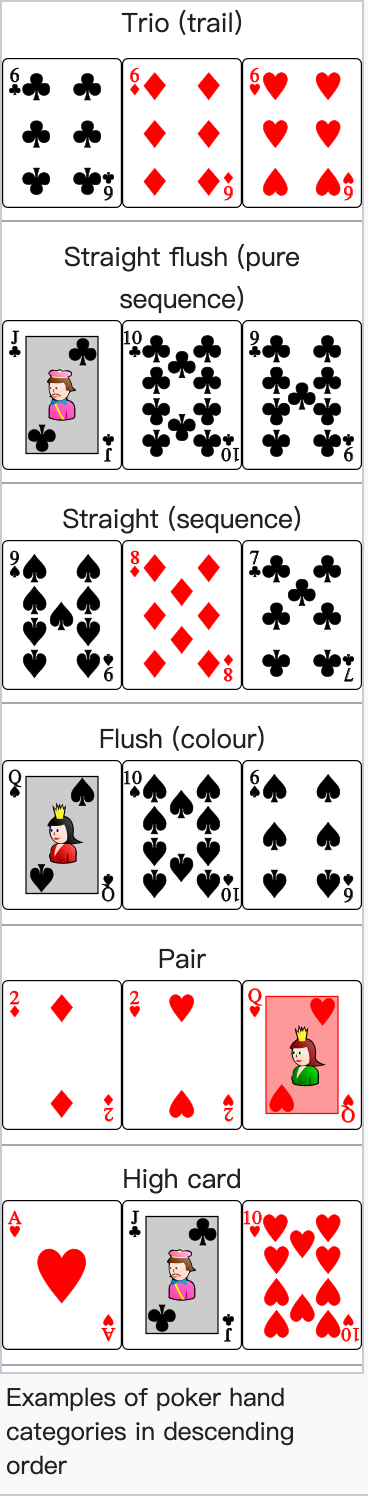
- Three of a kind (trio)
Three cards of identical rank. The hierarchy descends from three aces (highest) to three twos (lowest). - Straight flush (pure sequence)
Also referred to as Shahi and Pure run, this combination consists of three consecutive cards sharing the same suit. Rankings are determined by the highest card, descending from A-K-Q through A-2-3, K-Q-J, Q-J-10, down to 4-3-2. Note that K-A-2 combinations, while qualifying as flushes, are not considered straight flushes. - Straight (sequence)
Known alternatively as run, this combination features three consecutive cards of mixed suits. The ranking system mirrors straight flushes, with A-K-Q at the top, followed by A-2-3, K-Q-J, Q-J-10, descending to 4-3-2. Similar to straight flushes, K-A-2 combinations are invalid. - Flush (colour)
Three cards of matching suit. When comparing flushes between players, the highest card determines the winner. If these match, comparison moves to the second-highest card, and if necessary, the third. In cases of identical card values, suit hierarchy applies, with spades ranking highest and clubs lowest. - Pair (double)
Two cards of matching rank. Higher-valued pairs prevail over lower ones. When pairs are equal, the third card’s value becomes the deciding factor. The range spans from 2-2-3 (lowest) to A-A-K (highest). - No pair (high card)
When players share the highest card, subsequent cards are compared in descending order to determine the winner.
Probabilities
The following probability distributions apply specifically to standard 52-card teen patti game without Jokers. It’s important to note that in Joker variations, these probabilities undergo significant modifications, particularly affecting the likelihood of forming pairs.
The standard deck consists of 52 cards. While the order of dealing cards is inconsequential, what truly matters is the specific combination of the three cards received. To calculate the total possible three-card combinations from a set of n elements, mathematicians employ the combination formula nCr (represented as COMBIN(n,r) in Microsoft Excel and similar spreadsheets). Applying this formula to a 52-card deck, we find that the total number of possible three-card hands equals 52C3, which amounts to 22,100.
| Hand | Frequency | Probability | Cumulative Probability | Odds |
|---|---|---|---|---|
| Three of a kind/trio | 5 | 0.24% | 0.24% | 424.00:1 |
| Straight flush/pure sequence | 4 | 0.22% | 0.45% | 459.42:1 |
| Straight/sequence | 72 | 3.26% | 3.71% | 29.69:1 |
| Flush/colour | 1096 | 4.96% | 8.67% | 19.16:1 |
| Pair | 3744 | 16.94% | 25.61% | 4.90:1 |
| No pair/high card | 16440 | 74.39% | 100.00% | 0.34:1 |
| Total | 22,100 | 100.00% | 100.00% | 0.00:1 |
Interestingly, while pure sequences occur slightly less frequently than trios in natural probability, most game variants rank trios as the superior hand. To address this statistical discrepancy, many establishments implement a house rule that considers 2-3-5 of identical suit as a valid straight flush. This modification increases the total number of possible straight flushes to 52, matching the frequency of trios and thereby aligning the probabilities more evenly.
Variations

Teen patti game features numerous variant forms, and players often combine multiple variations within a single game.
Best-of-four in Teen patti game
In this variation, players receive four cards initially and must construct their optimal three-card combination from these options.
Lowball (mufliss)
This variant inverts the traditional ranking system, similar to lowball poker. The traditionally lowest-ranking combinations become the most valuable, while typically strong hands become less desirable.
For illustration, when comparing A-Q-3 against A-K-2 in standard play, A-K-2 emerges victorious (both hands contain an Ace, but K outranks Q). However, in lowball, A-Q-3 prevails (both hands contain an Ace, but Q ranks below K). In this variation, 3-2-5 represents the most powerful hand possible.
Wild draw in Teen patti game
After completing the deal, the dealer randomly selects one card and designates all cards of matching rank as wild cards.
Low wild in Teen patti game
Each player’s lowest-ranked card (along with all cards of identical rank) becomes a wild card in Teen patti game, applicable only to that player’s hand. When the two lowest cards form a pair, both cards function as wild cards.
High wild in Teen patti game
Each player’s highest-value card (and all cards sharing that rank) serve as wild cards exclusively within that player’s hand. In cases where the two highest cards form a pair, both cards are treated as wild cards.
Two-lowest wild in Teen patti game
Players receive four cards each, with their two lowest-ranking cards combining to create a virtual wild card that functions only in their hand. When the two lowest cards happen to be of the same rank, that pair may function as a single wild card inTeen patti game . However, if a pair appears in the middle ranks of a player’s hand, they forfeit the wild card advantage.
Bust card draw in Teen patti game
Following the deal, the dealer randomly extracts one card and declares all cards of matching rank as bust cards. Players holding any bust cards must immediately fold their hands.
Stud
This variant draws inspiration from stud poker. Players receive a predetermined combination of face-down and face-up cards. The concealed cards dealt to each player are known as hole cards (which inspired the common English phrase “ace in the hole,” suggesting a hidden advantage). The exposed cards are referred to as street cards.
This variation includes several formats, such as three-card stud, where players receive two concealed cards and one exposed card, and five-card stud (distinct from the poker variant sharing the same name), where players get two concealed and three exposed cards. Some five-card variations mandate players to form their three-card hand using one concealed card and two exposed cards in Teen patti game.
Community
Players start with an incomplete set of face-down cards in Teen patti game, followed by face-up community cards dealt to the table’s center. Any player can utilize these community cards to construct their three-card hand. This variant takes its cues from Texas hold ’em poker.
Available versions include:
- Three-card community: Players receive two face-down cards, followed by one shared face-up community card.
- Five-card community: Players receive two face-down cards, followed by three shared face-up community cards. Certain versions require players to construct their three-card hand using one face-down card and two community cards.
Draw
Each player receives a complete hand and is typically permitted to modify their cards either before or after betting (but not during both phases) by discarding unwanted cards and receiving replacements. Players might need to “purchase” replacement cards by contributing a predetermined amount to the pot for each new card. An alternative draw variant permits players up to three opportunities to purchase and modify their hand, exchanging one card at a time during the initial three betting rounds.
High-low split
In conventional Teen patti game, the entire pot is awarded to the player holding the strongest traditional hand. In lowball variations, the lowest-ranking hand claims the pot. High-low split variations divide the pot between two players: one holding the strongest traditional hand (designated as the high hand) and another with the lowest-ranking hand. Unlike traditional or lowball formats where typically only two players remain at showdown, in Teen patti game this variation can accommodate multiple players at the final reveal.
Sideshows are not permitted, and players maintain the option to fold rather than continue betting. Generally, players agree upon three or four betting rounds where no one folds before proceeding to showdown. Additionally, a maximum of six-to-ten betting rounds is enforced, after which a mandatory showdown occurs.
Two primary methods exist for high-low split games: “declaration” and “cards speak.” In declaration games, players must indicate (either verbally or using markers like chips) whether they’re competing for the high hand or low hand portion. The player with the lowest hand among low declarations wins that half of the pot, while the highest hand among high declarations claims the other half. In cards speak games, all players simply reveal their hands during showdown, allowing everyone to evaluate the hands; the highest hand secures half the pot, while the lowest hand claims the remaining half.
When multiple players tie for either high or low positions, the pot can be divided into quarters or smaller portions. For instance, if one player holds the highest hand at showdown while two players tie for the lowest hand, the high hand receives half the pot, while each low hand receives only a quarter share.
In cards speak variations, it’s typical to establish a “qualifier” – a specific hand value required to be eligible for the low portion of the pot. For instance, in games designated as “eight or better to qualify low,” participants holding eight-high hands (or lower rankings like seven-high) can compete for the low half of the pot (provided their hand outranks other low hands). However, players with 10-high or 9-high hands are ineligible to win, regardless of having the lowest hand among players.
In such scenarios, the high hand claims the entire pot. While high hand qualifiers are uncommon, one popular variant called “any pair/no pair” requires players to hold at least a pair to win the high portion, while only hands without pairs can compete for the low portion.
Kiss, miss, and bliss
Players receive five cards each. This variation introduces three categories of “virtual” wild/joker cards:
- Kiss: Two numerically consecutive cards form one virtual wild card; for example, A,2 or 8,9 or J,Q – though K,A isn’t considered valid.
- Miss: Two cards with one missing number between them constitute a virtual wild card; for instance, A,3 or 8,10 or J,K – however, K,2 isn’t permitted.
- Bliss: Two cards of identical numerical value (regardless of suit or color) create a virtual wild card; such as 8,8 or A,A.
Players can utilize any combination of these three types as virtual wild cards, with the restriction that each type can only be used once per hand. For example, a player might combine one regular card with a kiss and a miss, while another might play a regular card alongside a kiss and a bliss. However, using two kisses with a regular card isn’t allowed.
Cobra
In this variation, each participant receives one card and contributes a predetermined amount to the pot. Players place their unseen cards against their foreheads, allowing them to view everyone else’s cards while remaining unaware of their own. This variant typically serves as the final hand of the game session.
Blind (kaana) king and jack
Players receive three or four cards each. This variant designates kings or jacks showing a side profile with only one visible eye (such as the diamond king or spade jack) as wild cards. The round typically initiates when a player achieves a trio and continues until someone challenges a player holding the relevant king or jack to reveal their hand.